Brunei, officially known as Brunei Darussalam, is a small, wealthy (USD 35,103) oil- and gas-producing country located on the north coast of the island of Borneo in Southeast Asia. It shares a border with Malaysia and has a coastline along the South China Sea. Despite its size, Brunei is one of the wealthiest nations in the world due to its abundant petroleum and natural gas reserves. It has a rich history and is an Islamic monarchy.
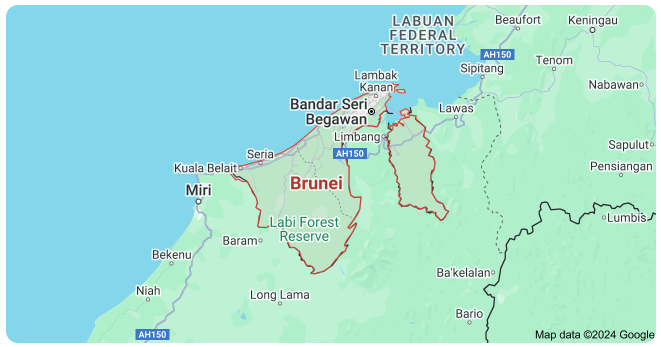
Key Information about Brunei
Capital: Bandar Seri Begawan
Population: Approximately 450,000 people
Language: Malay (official), but English is also widely spoken.
Currency: Brunei Dollar (BND)
Government: Absolute Monarchy
Sultan: Sultan Hassanal Bolkiah, one of the world's longest-reigning monarchs.
Economy
Brunei's economy is highly dependent on oil and natural gas, which make up the bulk of its exports and government revenue. The leader is the sultan of Brunai. The country enjoys a high standard of living (HDI 0.82) due to its vast petroleum wealth. The country has some tourism both positively and negatively portrayed - see here.
The country is one of the richest in the world in terms of GDP per capita due to its extensive oil reserves. Here are key aspects of Brunei's economy:
- Oil and Natural Gas:Brunei's economy is dominated by the petroleum sector, which accounts for around 90% of its exports and 60% of its GDP. The country is the fourth-largest oil producer in Southeast Asia and the ninth-largest exporter of liquefied natural gas (LNG) in the world.
- Diversification Efforts: To reduce its dependency on hydrocarbons, Brunei has been making efforts to diversify its economy. Key sectors targeted for development include Islamic finance, halal products, tourism, education, and technology.
- Islamic Finance: Brunei has positioned itself as a hub for Islamic banking and finance, aligning with its Islamic governance. The financial sector is growing and aims to become a key pillar of the country’s economy.
- Agriculture and Fisheries: Agriculture plays a small role in the economy, but Brunei has been looking to develop its fisheries and agribusiness sectors as part of its diversification strategy.
- Government's Role in Economy: The government of Brunei plays a significant role in the economy, with extensive subsidies and welfare programs funded by oil wealth. Citizens benefit from free healthcare, education, and no income tax.
- Economic Challenges: Economic Diversification: The heavy reliance on oil poses risks due to fluctuations in global oil prices, which can impact national revenue.
- Youth Unemployment: Despite its wealth, Brunei faces challenges such as youth unemployment, which the government seeks to address through job creation in non-oil sectors.
- Trade and Exports:Major export partners include Japan, South Korea, Malaysia, and China. Imports mainly consist of machinery, manufactured goods, and foodstuffs.
- Future Prospects: Brunei has been investing in renewable energy, technology, and eco-friendly tourism as part of its broader strategy to create a sustainable, diversified economy.
History
Brunei has a long and rich history, marked by periods of regional power, foreign influence, and, eventually, wealth from natural resources.Brunei was once a powerful sultanate in the 15th and 16th centuries, with its influence spreading across Borneo and the Philippines. However, it gradually declined in power until it became a British protectorate in the 19th century. Brunei gained full independence from Britain in 1984.
- Early History: Early Settlement -Brunei's history can be traced back to the 6th century when it was part of the ancient empire of Srivijaya. The earliest known state was a vassal of China and Indian empires.
- Islamic Influence: Islam was introduced in the 14th century, transforming Brunei into a sultanate. By the early 15th century, Brunei's first sultan, Sultan Muhammad Shah, converted to Islam and established it as the dominant religion.
- The Bruneian Empire (15th – 17th Century):
- Golden Age: Brunei reached its peak in the 16th century, controlling much of Borneo, the southern Philippines, and parts of Malaysia. The empire prospered from trade with China and other Southeast Asian states. During this period, Sultan Bolkiah (ruled 1485–1521) expanded Brunei's influence, and it became a regional maritime power.
- European Contact: The arrival of Europeans in Southeast Asia in the early 16th century began to erode Brunei’s dominance. The Spanish, who had colonized the Philippines, clashed with Brunei during the Castilian War (1578). This war and internal challenges weakened Brunei's regional power.
- Decline and British Influence (17th – 19th Century):
- Territorial Losses: Throughout the 17th and 18th centuries, Brunei lost control of much of its territory. Dutch and British colonialism in the region significantly impacted the sultanate. In 1841, James Brooke, a British adventurer, helped the Sultan quell a rebellion, and in return, he was given Sarawak (in modern-day Malaysia), which became a separate kingdom ruled by the "White Rajahs."
- British Protectorate: Brunei became a British protectorate in 1888, which meant that while the sultanate retained internal control, its foreign affairs were managed by the British. Brunei's territory continued to shrink during this period due to cessions to both the British and the White Rajahs of Sarawak.
- 20th Century and Independence: World War II: Brunei was occupied by the Japanese from 1941 to 1945 during World War II. After the war, British control was re-established.
- Discovery of Oil: The discovery of oil in Seria in 1929 transformed Brunei's economy and established it as a wealthy state. Oil and natural gas have since been the backbone of Brunei's economy, contributing to its high standard of living.
- Path to Independence: In 1959, Brunei signed a new agreement with Britain, which allowed it greater autonomy. A brief rebellion in 1962, known as the Brunei Revolt, was suppressed with British assistance. Brunei decided not to join the Malaysian Federation in 1963, preferring to remain a protectorate. Full independence from Britain was achieved on January 1, 1984 under Sultan Hassanal Bolkiah.
- Modern Era: Absolute Monarchy: Since independence, Brunei has been ruled as an absolute monarchy. Sultan Hassanal Bolkiah, who has been in power since 1967, is both the head of state and government.
- Sharia Law: In 2014, Brunei made international headlines when it became the first East Asian country to introduce Sharia Law. The law, which includes harsh punishments for crimes such as theft and adultery, has been controversial internationally but is in line with Brunei's official stance as a conservative Islamic state.
- Summary: Brunei's history has been shaped by periods of regional dominance, foreign intervention, and the discovery of vast oil resources. Today, it is a small but wealthy state with a unique blend of Islamic tradition, monarchy, and modern economic policies.
Religion
Islam is the dominant religion in Brunei, and the country follows Sharia Law alongside civil law. The implementation of Sharia Law has made international headlines, particularly with the introduction of strict penalties for certain offenses.
Tourism
Brunei is known for its beautiful mosques, including the Sultan Omar Ali Saifuddien Mosque and the Jame' Asr Hassanil Bolkiah Mosque. It also boasts rich biodiversity, with lush rainforests that are home to various wildlife species.
Though relatively small and not a major tourist destination, Brunei's wealth, Islamic culture, and natural beauty make it an interesting place to visit or study.
Famous people from Brunei
- Sulaiman
- Hassanal Bolkiah (current sultan/king)
- Craig Adams
- Jayna Oso
S. Midttun (c) 2024